
While you watch GPT vs. Gemini, a food delivery app is changing the rules of AI.
The public narrative, fixated on the costly spectacle of US titans like OpenAI and Google, is a distraction. The real battle for AI dominance is an open-source movement where the center of gravity has decisively shifted.
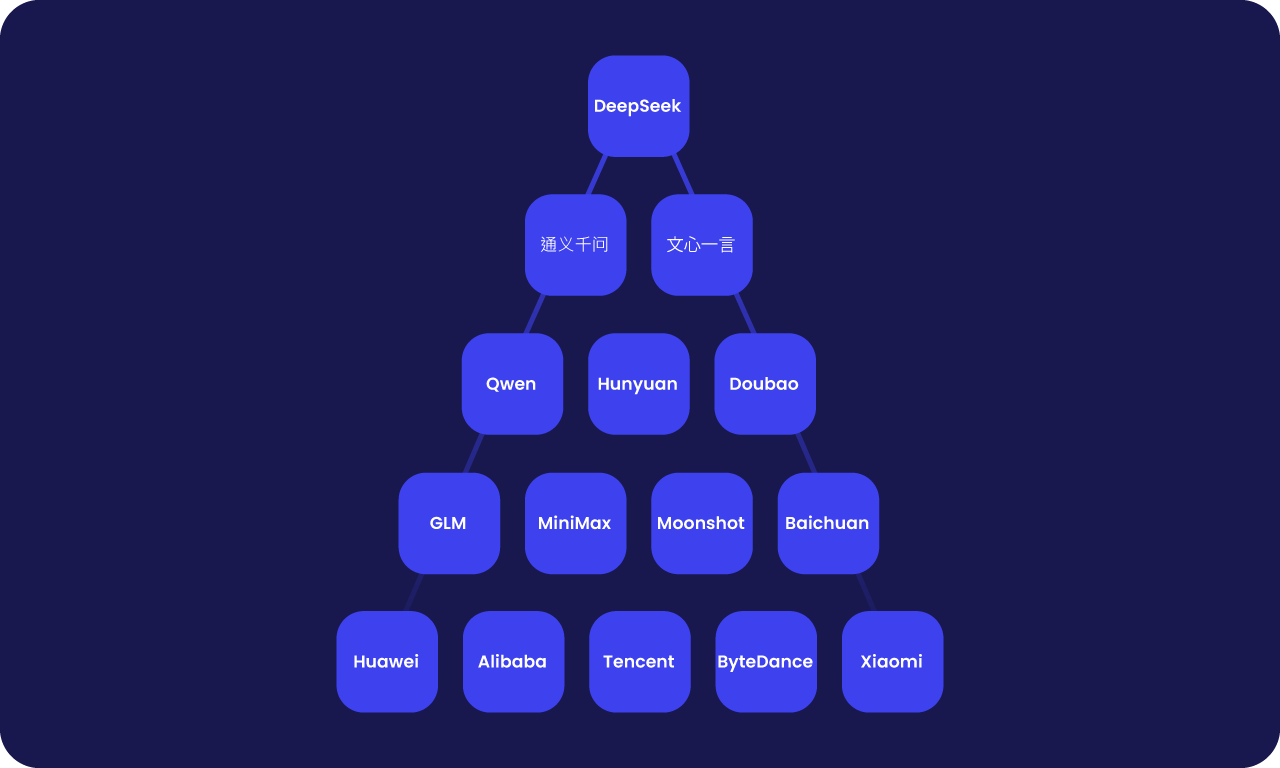
This shift is best understood as "The Chinese AI Iceberg." What you usually see is only a fraction of the story as the real disruption is happening beneath the surface. In mid-2025, a critical "flip" occurred: Chinese-developed open-source models surpassed US models in cumulative global downloads for the first time. By September, China was capturing nearly 65% of all new monthly open-source model downloads.
Not an accident. It is a strategy.
The Top: The Open-Source "Titans" You Know
Even at the surface, the players are formidable. The tip of this iceberg is led by two forces that have fundamentally altered the open-source AI landscape.
- DeepSeek: Now widely considered a top-tier open-source lab, DeepSeek's models are not just "good for open-source"; they are challenging the best private models in the world, especially in high-value domains like coding and mathematics.
- Alibaba (Qwen): Alibaba's Qwen series has become the new "cornerstone" of AI research. Where Meta's Llama once stood, Qwen is now the go-to foundation for countless academic papers and new startups.
Let's Try Swimming: The New Wave of AI Giants
Just below these giants, a new class of hyper-efficient Chinese AI startups is proving that building elite AI is no longer a game that requires $100 million+ budgets.
The most prominent example is 01. AI. Founded by AI legend Kai-Fu Lee, the company hit a $1 billion valuation in a mere eight months. How? It trained its initial Yi-series models for only $3 million. This proves a new, capital-efficient path to SOTA performance exists, and it's being aggressively pursued.
This layer is dense with other powerhouse startups like Moonshot AI (known for its Kimi model) and Zhipu AI (creator of the GLM series), which are consistently setting new benchmarks on global leaderboards.
Case Study: DeepSeek vs. Llama 3 — For The Developers
This brings us to a critical search-intent question: Are these new Chinese AI models actually better than Llama 3?
The answer is nuanced but powerful. Meta's Llama 3 is a phenomenal generalist. But in high-value specialized tasks, the answer is increasingly yes.
- On the MATH benchmark: DeepSeek-R1 achieves a staggering 97.3% score, far surpassing Llama 3.3's 77%.
- In coding: On the popular Codeforces benchmark, DeepSeek's models consistently outperform Llama.
But performance is only half the story. The real disruption is cost.
DeepSeek V3's innovative Mixture-of-Experts (MoE) architecture is estimated to be 35.7 times cheaper for output tokens than GPT-4o. This isn't just an upgrade; it's a fundamental change in the economics of AI.
The Deepest Level: The Food Delivery Guys Conquer The Hard AI
This brings us to the base of the iceberg, the part that’s invisible to most Western observers and the most profound signal of change.
In September 2025, Meituan, a $100B+ conglomerate known primarily for food delivery, released its model: "LongCat-Flash-Thinking." This wasn't a simple chatbot. It was a 560-billion parameter MoE model that challenged other top-tier models.
Let that sink in. A non-tech company, whose core business is logistics and reviews, has the capability and strategic drive to produce and open-source a SOTA AI model.
They weren't alone; the social media app Xiaohongsu did the same. When this happens, it signals the ultimate truth. AI is no longer a scarce "product." It has become a utility.
Analysis: China's Strategy of AI Commoditization
This answers the final question: Why are they all doing this? Why would a food delivery app give away its most advanced tech for free? Because this is a deliberate strategy of AI commoditization.
As expert David Woo, CEO of David Woo Unbound, has stated, the US strategy is to monopolize AI through high-cost chips and closed-source systems. China's strategy is to "commoditize this entire technology," turning it into a zero-cost tool.
Why? Because the battle shifts from who builds the model to who uses it best. By open-sourcing the "engine," these companies empower a global army of developers to build applications on top of their platform. The value is no longer in possessing the AI; it's in the integration and the application.
The Real AI Race Has Now Changed
This structural shift demands an immediate change in business strategy.
- For Developers: Your toolbox just received a massive, free, and continuous upgrade. The barriers to building world-class AI applications have evaporated.
- For Businesses (CTOs): Your entire AI roadmap must pivot. Stop waiting to buy the "perfect" model from a US titan. The old question was, "Which model should we acquire?"
The new, urgent question is, "How fast can our integration architecture deploy the best open-source model for the job?" The future of AI is not a walled garden. It's a multipolar, open-source world. The race to build AI is quickly ending. The race to apply it has just begun.



